Observation is a key tool in early childhood education, enabling educators to understand and support children’s unique learning journeys. Influenced by Eurocentric frameworks, traditional assessment methods focus on standardized testing and measurable outcomes. Traditional assessment methods have their benefits, but they may overlook a child’s individuality and fail to capture their cultural context and diverse ways of learning.
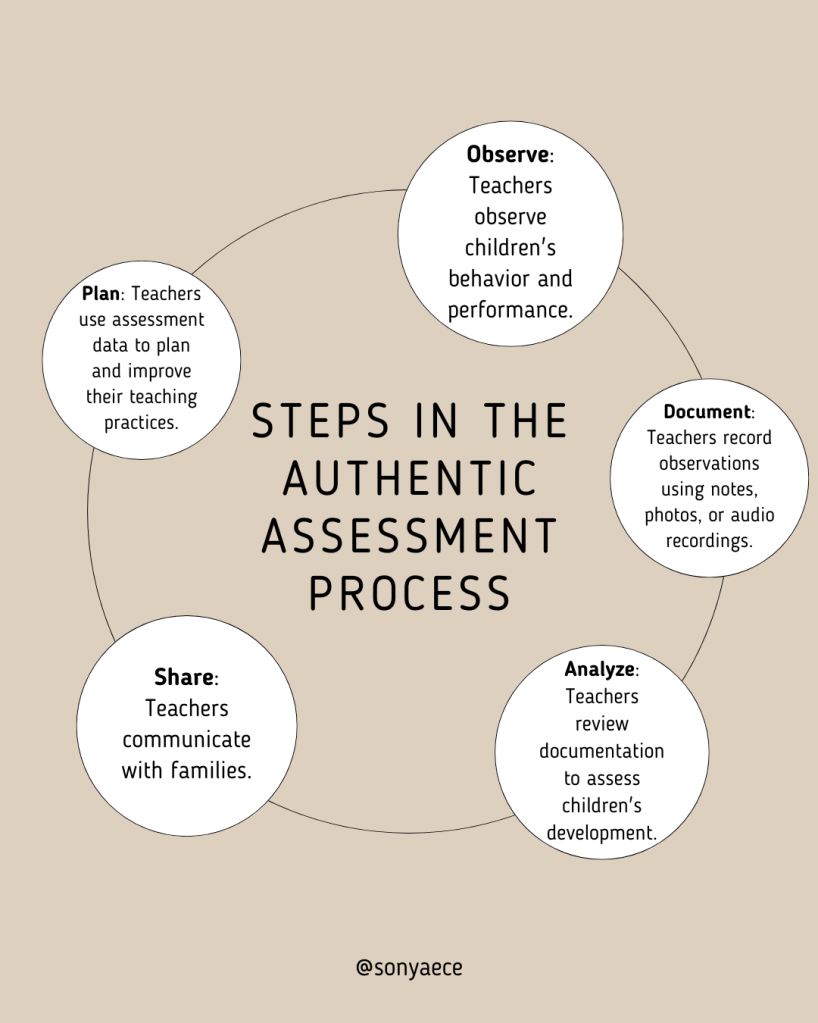
Authentic assessment embraces a more holistic and inclusive method of observation. It acknowledges children’s strengths, interests, and learning styles, allowing them to demonstrate their understanding through different ways of expression. Through the learning of authentic assessments, I also learned the indigenous framework Two-Eyed Seeing, which integrates Indigenous and Western perspectives for a more balanced, inclusive, and effective approach to observation and assessment.
From my previous experiences, traditional observation methods often emphasize structured assessments and measurable outcomes based on developmental milestones. While these approaches provide consistency, they may also focus more on what children lack, rather than celebrating their strengths. For instance, standardized tests may not fully capture a child’s understanding if they prefer to express themselves through storytelling, play, or creative activities rather than traditional reading and writing skills.
Indigenous Ways: Two-Eyed Seeing and Slow Pedagogy
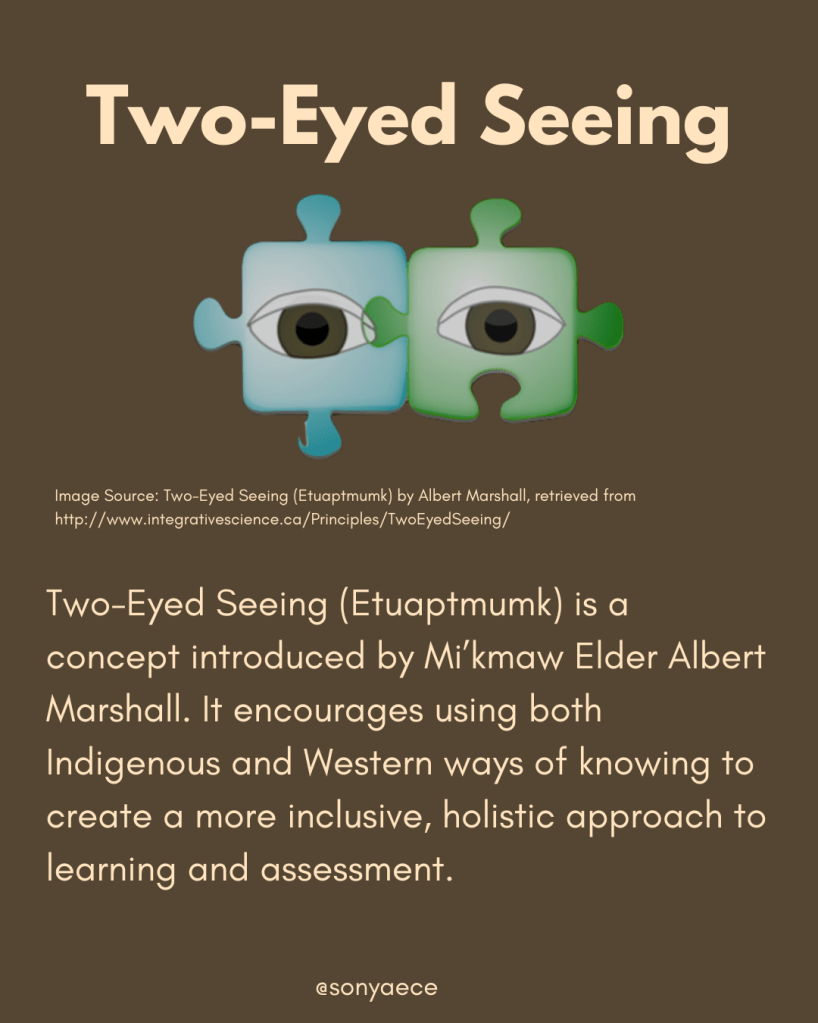
Two-Eyed Seeing is a concept introduced by Mi’kmaw Elder Albert Marshall, which encourages educators to view the world through two perspectives: Indigenous and Western knowledge systems. This framework fosters inclusivity, helping to integrate both sides of views to address challenges in a balanced, respectful way ( Marshall, n.d.).

Slow Pedagogy advocates self-realization (Jukić, 2022) emphasizes a slower, more thoughtful pace of education. It recommends on strategies such as project learning, problem-based and collaborative learning, service-learning, just in time teaching, and flipped classroom (Jukić, 2022). It leads to in-depth understanding.
How Authentic Assessment Supports Both Perspectives
Authentic assessment moves beyond traditional testing by observing children in natural settings. It focuses on their interactions, problem-solving abilities, creativity, and emotional growth. This allows children to express their learning in ways that feel relevant to their cultural backgrounds and personal experiences.
By considering Two-Eyed Seeing approach in their observation and assessment, educators can consider both Western and Indigenous ways of knowing, helping create an educational environment where all children feel seen, heard, and valued for their differences.
Reflections on New Concepts Learned
What did I learn? I have gained a deeper understanding of the importance of integrating both different approaches to observation and assessment. From my personal experiences, learning is happening naturally with my interests and intention. My value of learning and study is the same as the concept of Two-Eyed Seeing. The concept of Two-Eyed Seeing emphasizes that each child’s learning is unique and should be assessed in ways that are relevant to their cultural background and personal experiences. Additionally, Indigenous slow pedagogy has taught me the importance of a thoughtful, experiential approach to education.
So what? This learning has inspired me because it highlights that traditional assessments are not able to fully capture a child’s abilities, especially when they are expressed through different cultural lenses. By embracing a more inclusive, flexible approach to assessment, educators can support children in a way that respects their individuality and cultural identity.
Now what?
At my practice, I plan to:
- Observing children in ways that respect their cultural backgrounds and personal learning styles.
- Using narrative observations, storytelling, and play-based assessments.
- Involving families and communities in the assessment process, ensuring that the child’s learning environment reflects the collective knowledge and cultural heritage around them.
References:
Marshall, A. (n.d.). Two-Eyed Seeing (Etuaptmumk). Integrative Science. Retrieved from http://www.integrativescience.ca/Principles/TwoEyedSeeing/
Authentic Assessments EDUC 2000 CURR III (2025). CURR 3 Authentic Assessment. Retrieved from https://sam.hollandcollege.com/d2l/le/content/73555/viewContent/2933054/View
Jukić, T. (2022). Slow Pedagogy and Contemporary Teaching Strategies.
 Island Memories